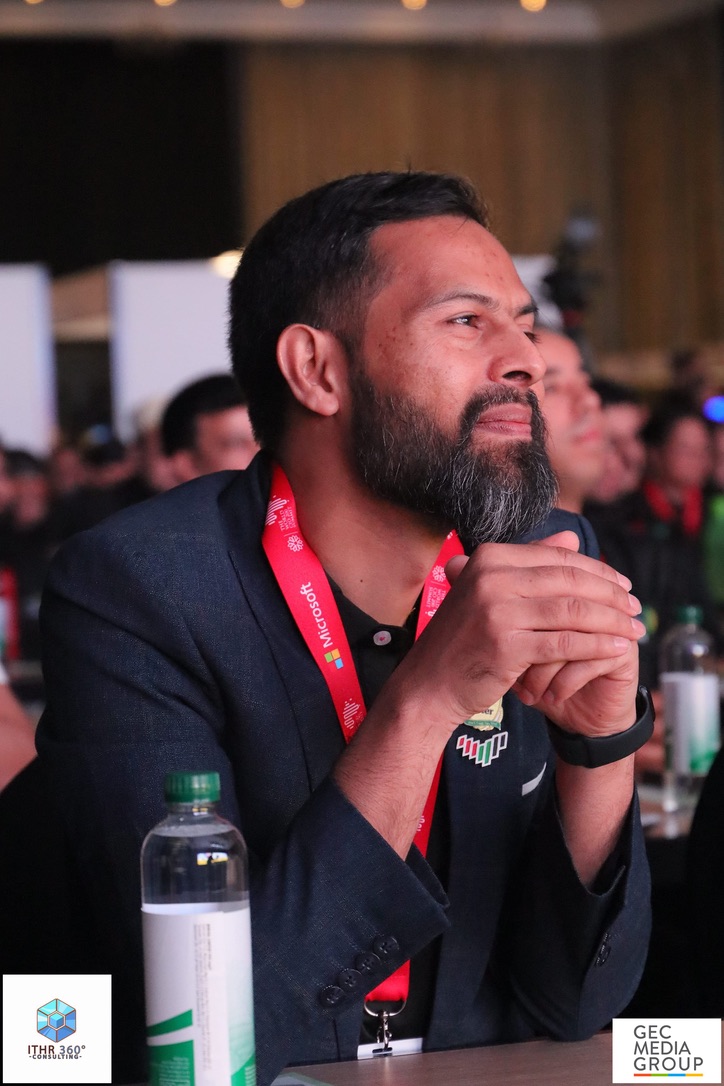
 Founder interview · 2026-08-07
Padam Sundar Kafle, the paradigm behind AlifZetta Superintelligence
Ten questions on Superintelligence, Green Intelligence, and why the AI industry has taken the wrong architectural bet.
Padam Sundar Kafle is the Founder and Chief Engineer of AlifZetta Superintelligence, a sovereign SI platform born out of a simple observation: the AI industry has bet its entire architecture on the wrong direction. The industry says LLM plus vector database plus RAG plus Chain-of-Thought. Padam says CLLM plus NEXUS plus LATTICE plus PRISM. He calls the difference Superintelligence rather than AI, a substrate that grows every thirty minutes rather than a model frozen at a training cutoff. Twenty-one years of engineering across thirty-five countries, a doctoral thesis at Università degli Studi Guglielmo Marconi on Healthcare Superintelligence, two published books, and a live deployment inside the Nepal Government's Office of the Prime Minister, that is the credential ledger behind the argument. This interview lays out the paradigm in his own words: why AI has a ceiling, what Green Intelligence really means, why sovereignty is the healthcare deal-breaker, and why Nepal, not Silicon Valley, is the right proving ground for the next architectural bet.
Q1. Why call it Superintelligence and not AI?
Because the word artificial is doing work I do not want done. Artificial means made and finished. Every frontier LLM you use, GPT, Claude, Gemini, is frozen at its training cutoff. What it knew on release day is what it will ever know, until someone spends nine figures retraining it. That is a ceiling. Super means beyond. AlifZetta's NEXUS substrate refreshes every thirty minutes. The corpus you queried at nine in the morning is not the corpus you query at nine-thirty-one. That distinction is not marketing, it is architecture. Superintelligence is a substrate-time property, not a training-time property.
Q2. What is Green Intelligence, and why now?
Green Intelligence is the observation that our entire stack, CLLM plus NEXUS plus LATTICE plus PRISM, runs on commodity CPU. A single active AlifZetta inference node draws roughly one hundred watts. The equivalent-throughput GPU cluster draws ten thousand. That is a two-order-of-magnitude delta on energy, on data-centre cooling, on rare-earth demand for GPU supply chains, on e-waste. If the world is going to deploy Superintelligence at population scale, the power grid has to accommodate it. Green Intelligence is the only path where that is physically possible. It is not a bolt-on sustainability narrative. It is the architecture.
Q3. How does AlifZetta beat Retrieval-Augmented Generation?
RAG is a hack around not having a graph. It says: our LLM does not know this, so let us stuff a chunk into the prompt and hope the model integrates it correctly. It works, partially, at high latency, with brittle top-k tuning. LATTICE, our replacement, walks the NEXUS graph deterministically from the query's anchor entities. There is no similarity threshold to tune. There is a path, or there is not. Sub-five-millisecond retrieval on ninety-thousand-plus typed entries via a compiled inverted index. And every hop is human-readable, I can show you the traversal, delete a node, and watch the answer degrade. That is what verifiable retrieval looks like.
Q4. PRISM versus Chain-of-Thought, what changes for the buyer?
Chain-of-Thought is a story the model tells itself, and then we believe the story. There is no independent check that the intermediate step actually happened or that it references anything real. It is coherence theatre. PRISM, Proof-Rooted Inference from Structured Memory, refuses that theatre. Every reasoning step must anchor to a NEXUS entity with a citation. The answer ships with a walkable tree. For a hospital CIO or a ministry auditor, the question is no longer 'is this model accurate?' It is 'can I audit any given answer end-to-end?' We are the only architecture where the honest answer is yes.
Q5. Why is AlifZetta built in Nepal, not Silicon Valley?
Because Silicon Valley is a saturated market where the axis of differentiation is benchmark points. Nepal is an unsaturated market where the axis is whether a citizen can actually get their pension approved. Nepal gives us bilingual constraint, English and Nepali, a three-tier government structure, a seasonal disaster cycle from monsoon to earthquake to dengue, and a healthcare gap you can measure in maternal-mortality figures. Once you serve Nepal end-to-end, you can serve any emerging economy in Asia, Africa, or Latin America. That is five billion people the frontier labs are not seriously chasing. Sovereign SI made for the underserved majority, that is our thesis, and Nepal is the proof.
Q6. Zero external LLM calls at inference, is that real?
Yes, and it is auditable. Run grep across our production tree. No OpenAI. No Anthropic. No Google. No Gemini. Not a single hostname of a frontier lab appears anywhere in the inference path. The entire stack, CLLM, NEXUS substrate, LATTICE traversal, PRISM proof-tree composer, SILL vGPU runtime, is sovereign and runs on the customer's own hardware. This is not a nice-to-have. It is the licence to operate inside government, healthcare, defence, and finance in this decade. Any vendor whose architecture assumes a US-hosted round-trip cannot bid on those contracts, cannot pass their audits, and cannot survive their data-residency laws. Sovereign inference is the deal-breaker most competitors have not yet noticed.
Q7. How does a doctoral thesis fit into a product company?
The thesis is the falsifiable version of the product. My doctoral research at Università degli Studi Guglielmo Marconi asks a specific question: is Superintelligence a training-time property or a substrate-time property? The industry has bet training-time, bigger models, more parameters, more tokens. My argument is that the substrate-time bet is structurally better for healthcare, and AlifZetta is the working proof. The thesis and the company are the same claim, tested two different ways. If the thesis survives peer review, that is defensible corporate positioning. If the product survives production, that is defensible academic evidence. They reinforce each other. That is the only reason to do both at once.
Q8. What does the healthcare deployment look like on the ground?
Live at under the Nepal Government's Office of the Prime Minister. Three hundred and nineteen ICD-11 clinical pathways. Bilingual triage in English and Nepali. Nine interactive scorers, chest pain, headache with SNNOOP10, fever with qSOFA and WHO dengue, snake bite with Nepal-species stratification. Sub-three-millisecond partner-API latency. Full drug-safety cross-check for interactions, allergies, and conditions. The whole stack is on-premise, sovereign, cited, and running twenty-four hours. It is not a demo. It is production infrastructure for a nation of thirty million people, and it is our proof that this architecture ships.
Q9. What is a CLLM, in one paragraph?
A CLLM, Cluster Large Language Model, is our answer to the LLM. Where a standard LLM is trained on a trillion tokens of internet dump and hallucinates when uncertain, a CLLM is fenced by a citation contract: every token it emits must anchor to a NEXUS entity. It cannot fabricate. It can only answer or route. You lose the parlour-trick creative writing. You gain the ability to sign a contract that says the system will never make up a claim. For every enterprise buyer who is trying to figure out why they cannot yet deploy generative AI in their real workflows, that trade is the entire game.
Q10. Where does this go next?
Three tracks in parallel. First, deepen the substrate, one blog post per day, one daily-pulse KB drop per day, one Green Intelligence field-note per day, so the ninety-five-thousand-entry NEXUS crosses one hundred thousand this quarter. Second, expand the deployment, from the Nepal government partnership to at least two more South Asian ministries and three hospital groups by year-end. Third, publish the thesis and the second edition of the whitepaper as the paradigm paper, the version we will hand to every analyst, regulator, and buyer who asks the question the industry is not asking yet: what if the frontier is not bigger models, but a better substrate? AlifZetta is that answer. Green Intelligence is why it can scale. Sovereignty is why anyone can afford it. Nepal is the proof it works.
The vocabulary at a glance
Where the industry says LLM, AlifZetta says CLLM. Where it says vector database, we say NEXUS. Where it says RAG, we say LATTICE. Where it says Chain-of-Thought, we say PRISM. Where it says trillion-token dataset, we say Smart Router Dataset. Where it says GPU, we say SILL. Where it says AI, we say Superintelligence.
Read the whitepaper → Daily field notes →